

With Eraserhead, David Lynch proved himself a master of the waking nightmarescape. In The Elephant Man, he brought a sense of that surrealism to a biopic. Dune proved he wasnt the guy to make a four-quadrant blockbuster.
But it wasnt until Blue Velvet now out in a 4K edition from the Criterion Collection that he really became the David Lynch we know today. Twin Peaks, with its three incarnations of TV series, movie, and premium cable revival, may never be surpassed as his epic masterpiece. However, Blue Velvet was the dry run for nearly everything in there. It was the first time on the screen that his dark subconscious met, clashed, and contrasted with his all-American Boy Scout personality.
Just like Lynch himself, his movies and TV shows from then on would make you wonder what darkness lies beneath the borderline cornball surface layers. Its hard to know at times whether hes being ironic or just weird, and certainly, hell never tell. The often deadpan tone he uses to depict characters acting bugf insane in both harmless and menacing ways hasnt always been easy to read, but by now, we know it well enough to call it Lynchian.
Eye of the Beholder
Now that critics universally rate Blue Velvet a classic, its hard to believe the film had a divisive hurtful, even reaction at release. On the London Underground, guerilla feminists vandalized the movie posters with phrases like Stop the exploitation of women. Roger Ebert, who ought to have known better after working with Russ Meyer, went off on the movie as if David Lynch had really beaten and assaulted female lead Isabella Rossellini. In fact, he arguably made her a movie star, as he did Kyle MacLachlan, whose career was almost over before it had begun when Dune tanked.
Dennis Hopper, meanwhile, was considered an unhireable whackjob in the mid-80s, but Lynch got him (almost) straight out of rehab and on his best behavior, kickstarting a comeback that would see him ultimately become a major A-list villain in movies like Speed and Waterworld. Laura Dern and Dean Stockwell also saw their stock rise.
Archie Goes to Hell
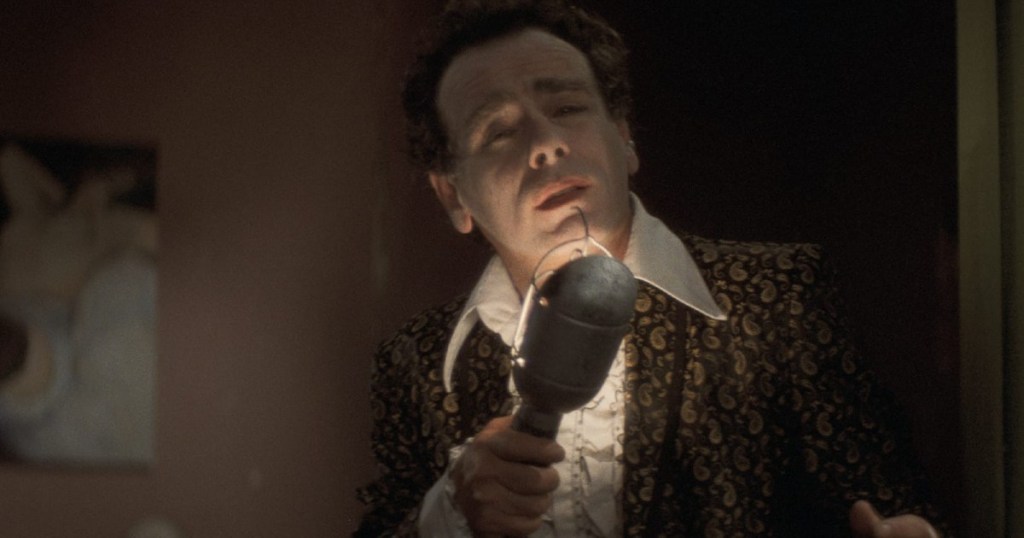
Watching Blue Velvet now, its easy to be struck anew by all the things that have become Lynchian hallmarks. He loves ethereal singers in mysterious clubs, dark black hallways in which little is visible, except perhaps when a character might step forward into an unseen spotlight. Industrial landscapes feel apocalyptic, while a soundtrack featuring either slow drones or carnival-like score messes with the mood. Wacky character quirks can give way to brutal violence, and like Twin Peaks, Lumberton is a sawmill town populated by weird adults and hot, older-than-they-look teens.
The CWs Riverdale may have made Archie Andrews comic world dark and strange, but only because Lynch nailed that vibe of Archie comics with dark undertones first. The 4K transfer really makes both the bright flowers and the barely lit night scenes rich and deep, and the optional 5.1 audio allows the actors to be better heard amid occasional cacophonies on the soundtrack. Blue Velvet has not looked this good in quite a while.
WaitThe Plot Resolves?
Whats most surprising in hindsight or maybe not is that the story is reasonably coherent, especially so for Lynch, with a beginning, middle, and end in that order. Though its sometimes described as a mystery film, its pretty clear the moment Hoppers Frank comes onscreen that hes the guilty party. Its also a story, like Raiders of the Lost Ark, in which the hero could probably be removed completely from the narrative and the villains defeat might be equally assured (we never do know how much the good cops actually figure out by themselves). The tension comes from whether Jeffrey Beaumont (MacLachlan), home from college to see his sick father, can escape Lumbertons dark underbelly once he has seen it and more crucially, it has seen him.
Had Lynch had his way with an initial four-hour cut, the movie would have been even more Twin Peaks-y. Fifty-two minutes of deleted scenes and outtakes are edited together on the Blu-ray disc of extras, and they include a subplot about Aunt Barbara obsessing over termites, and more than one scene of MacLachlan drinking coffee and enjoying dessert. Additional lounge acts include some extremely weird performers opening for Dorothy (Rossellini), and in the most drastic change to the story, Jeffrey meets Sandy (Dern) for the first time when visiting her father, as opposed to the final cut that presents them as familiar to each other.
Megans Low
Jeffreys backstory was originally far more fleshed-out, and not necessarily for the better. We see him being voyeuristic in college, learn that hes home because his fathers medical expenses mean that the family can no longer afford tuition, and even see Megan Mullally playing his college girlfriend, with whom he gradually breaks up over the phone through the course of multiple scenes.
Its a shame for Mullally, who could have used the early career boost, but good for the movie. Its better we dont know too much about Jeffreys backstory, and frankly, the deleted scenes often feel more like the sort of scenes producers usually insist must be added in for clarity rather than removed. Lynch had the final cut, but not to the point of rendering the length unreleasable. Much of the ambiguity that has become his style seems to have been partially the outcome of necessary trims for time that really worked out creatively for the bestas they absolutely did NOT in Dune.
FallingIn Love
Blue Velvet is also formative for the Lynch canon in that its the project on which he met regular musical collaborators Angelo Badalamenti and Julee Cruise, in a story youll hear told at least three times if you watch all the extras. Theres no need to recount the details here, but suffice it to say that Cruises now-signature ethereal voice was not a thing until Badalamenti was tasked by Lynch with making a ripoff of This Mortal Coils Song to the Siren. Thats the directors favorite song ever and a pretty freakin hip choice in 1986, which he was finally able to afford for Lost Highway (though not enough to get it on the actual soundtrack album).
Although there is definitely a tendency in todays mediascape to valorize the wrong things witness fans of The Boys who think Homelanders a hero its hard to imagine most thinking critics today dismissing Blue Velvet as simple misogyny. Some such accusations might even be considered kink-shaming: can we not tell the difference between a woman in a consensual sex scene asking to be slapped and that same woman being hit and brutalized against her will? Is it not abundantly clear that Frank is an irredeemably evil character?
Ebert asked if all the violence was in the service of anything valid, and maybe it takes knowing what we know now of Lynch, but even my Boomer father, watching the movie when it came out, said it made him think twice about what was under the surface in his own idyllic hometown. Its a pointed reminder that people and places contain hidden multitudes, and the image being sold isnt always what you get. Ironically, protesters reacting to superficial details proved that point.
Pre-Mystery Man
Lynch, in more recent years, has carefully managed his enigmatic auteur aura by refusing to talk about his films, doing commentaries, or even offering plot synopses in their press kits. He didnt yet have that privilege in 1986 and even invited a German art student named Peter Braatz to document the filmmaking process simply because Braatz wrote to him and asked him. That 89-minute feature, entitled Blue Velvet Revisited, is included here in its entirety. At first, it seems insufferably experimental, but once Lynch and others start talking, some enlightening quotes and stories emerge, including some spot-on predictions by Lynch about the future of computers and tiny cameras in filmmaking.
A more conventional documentary, Mysteries of Love, seemingly transferred over from a previous MGM DVD, offers the equivalent of a commentary track from MacLachlan, Rossellini, an older interview with Lynch, and more.
Thats not all. A third, much-shorter documentary that runs about 15 minutes catches up with some of the crew and actor Fred Pickler (the Yellow Man), as they revisit some of the old locations, and we learn that was David Lynchs actual hair on the severed ear prop, which uses a lot of anatomical cheats in order to actually come across onscreen as an ear. In an audio-only segment, Lynch reads aloud for about 20 minutes from his book Room to Dream, coauthored by Kristine McKenna, from the chapters on Blue Velvet; the booklet that comes with the Digipak includes further excerpts.
Ear Today
Minus a commentary, its hard to imagine what more a fan could want on this collection. All the extras previously came with the Criterion Blu-ray, so the lure for the 4K is simply a darker, more vivid transfer. Lynch purists will want to go for it; those who never picked this up before absolutely must. Itll tell you more about Lynch and his art than any interviewer has managed to extract from him in the last twenty years or so.
Grade: 10/10
Under ComingSoons review policy, 10 is a masterpiece. This is the rare release that transcends genre and must be experienced by all fans of the medium.
The Criterion Collection 4K multipack of Blue Velvet hits retail on June 25.
The post Blue Velvet Criterion 4K Review: When Lynch First Peaked appeared first on ComingSoon.net – Movie Trailers, TV & Streaming News, and More.
Blue Velvet Criterion 4K Review: When Lynch First Peaked on www.comingsoon.net. Keep reading.


