

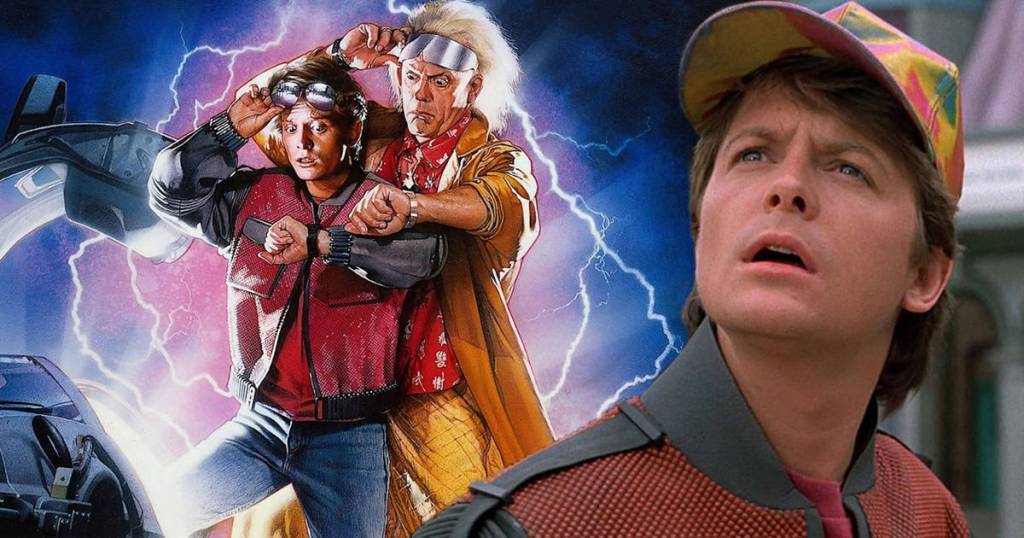
The year was 1989 when Michael Keaton first donned the cape and cowl for Tim Burtons Batman, Cher wanted to turn back time, and Marty McFly bungled the most sure-fire get-rich-quick scheme in cinematic history in Robert Zemeckis Back to the Future Part II.
After the monumental success of Back to the Future, Univeral Studios approached Robert Zemeckis about creating a sequel to his film that had quickly become a pop culture touchstone. Hesitant about capturing lightning in a bottle twice, Zemeckis said he wouldnt make the film unless Michael J. Fox and Christopher Lloyd returned as Marty McFly and Doc Brown, respectively. Thankfully, both were game to gas up the DeLorean and push the speedometer to 88mph for another excursion through time. With Fox and Lloyd confirmed, Zemeckis arranged his ceremonial objects to summon his writing partner, Bob Gale, to determine where Marty and Doc would travel next.
While Zemeckis was filming his hybrid animated masterpiece Who Framed Roger Rabbit, Gale began scripting the time-traveling sequel. To the duos dismay, they quickly remembered that Martys girlfriend, Jennifer, played by Claudia Wells in the original, sits shotgun with Marty in the DeLorean in the classic films final scenes. Like it or not, Jennifer needed to be a part of the next clock-manipulating caper. Embracing the circumstances, Gale and Zemeckis began developing a plot to take Doc, Marty, and Jennifer into the hereafter to change a pivotal event in the couples future.
Speaking of the future, Back to the Future Part II abandons the cardigans and poodle skirts of the 1950s for an ambitious look at 2015, the year promising hoverboards, self-cleaning smart jackets, and holographic screenings of Jaws 19. While feeling excited about presenting audiences with a radical glimpse of the future, Zemeckis and Gale grew nervous about making far-flung predictions regarding technology and transportation in 2015. Some divinations, like hands-free gaming, waste-fuel cars, and biometric devices, came to fruition. Still, many await a world populated by robotic dog walkers, food hydrators, and flying cars. However, do we trust casual drivers to own and operate flying automobiles? Imagine the cost of gas, infrastructure planning, and the frustration of flying behind student drivers. Ill stick to rubber tires on pavement, thank you very much!
The fact that I still remember my first screening of Back to the Future Part II is a testament to the sequels impact and lasting appeal. Ask anyone who knows me about my memory, and theyll tell you its laughable garbage. Add a strong case of inattentive ADHD to the mix, and youve got a recipe for an unreliable narrator. However, theater experiences tend to stick with me, and Ill always remember when and where I watched Back to the Future Part II for the first time.
Released on November 22, 1989, as a pre-game to Thanksgiving in the United States, Back to the Future Part II sent 1.21 gigawatts to my brain as my imagination ran wild with visions of the years to come. At eight years old, my mom and I saw Back to the Future Part II at the Brookhaven Multiplex in Medford, New York. While Zemeckis time-traveling sequel played in a packed theater, the film reunited audiences with Doc and Marty and teased a radical future filled with tech that could alter the everyday lives of millions.
While audiences sat slack-jawed at the promise of a tech-driven future and marveled at the cleanliness of Hill Valleys busy city streets, Zemeckiss sequel erred on the side of hope. It presented an ideal future where climate change is the stuff of science fiction, and the Chicago Cubs stand a chance of winning the World Series. Funnily enough, the Cubs achieved this feat in 2016, one year after Zemeckiss playful jab at the players led by Clark, the mascot bear with the backward baseball cap.
Speaking about his depiction of the future on the films audio commentary, Zemeckis said the future scenes were his least enjoyable to film in the trilogy because he didnt like predicting what lies ahead. Like in A Clockwork Orange, he preferred Kubricks depiction with an aesthetic akin to IKEA and NASA partnering for a fall collection of designer furniture. Rather than striving for precision, Zemeckis and Gale leaned into far-flung concepts, pipe dreams, and predictions made by actual scientists. Zemeckiss school of thought was he could present the future as funny while possibly inaccurate.
Astonishingly, Back to the Future Part II was produced on a $40 million budget, which some would consider couch change by todays lofty standards for a blockbuster film. The set-building and scripting process lasted two years, with the sequel serving as a landmark project for Industrial Light & Magic. While the effects shown in Back to the Future Part II appear dated compared to effects powerhouses like James Camerons Avatar franchise and Marvels superhero slugfests, Doc and Martys sophomore adventure was nothing short of jaw-dropping at the time of release. I can still hear the random gasps of audience members from my screening and recall my wide-eyed wonderment as Marty shredded through Hill Valley Square atop a borrowed pink and orange Mattel hoverboard.
One of the crowning achievements of Back to the Future Part II was the films ability to make audiences believe that Zemeckiss future was possible. The public desperately wanted to dream about driving flying cars or tricking like Tony Hawk with an anti-gravitational skateboard. Zemeckis fanned the flames of imagination in a behind-the-scenes featurette, saying the hoverboards featured in the film were real but would only be released to the public once the government could determine safety regulations. People fell for what was later dubbed the Hoverboard Hoax, hassling toy outlets like Toys R Us and KB Toys for stock updates and expectations.
Other technological milestones include ILMs maiden voyage into digital compositing, combining multiple images into a final display, and using the VistaGlide motion control camera system to film scenes featuring an actor playing numerous roles simultaneously. While Zemeckis used VistaGlide to film a scene of Michael J. Fox playing three separate characters at the same time, the characters Marty Sr., Marty Jr., and Marlene, a better example of this filming method is the 1996 comedy Multiplicity, starring Michael Keaton as a clone-happy contractor using science to gain more free time.
While planning Back to the Future Part II, screenwriter Bob Gale proposed adding a fourth act set in the Wild West. However, taking Doc and Marty to the American frontier meant pushing the runtime to two and a half hours with an estimated $60 million budget. When Universal shot the idea down faster than Marty, channeling his Wild Gunman skills to ping targets at Colts Patent Firearms, Gale returned to the drawing board. Reluctant to sunset his ideas for traveling to the Old West, Gale split the script in half, turning Back to the Future into a trilogy. Each film cost the studio $40 million to produce, with the projects shooting back-to-back over 11 months. Universal, while hesitant to pony up the dough, saw dollar signs in turning an already beloved property into a triple threat.
The day I saw Back to the Future Part II at the Brookhaven Multiplex, Universal attached a preview of the third film to tease audiences about the storys continuation. If memory serves, this was the first time Id seen a preview for a sequel attached to a film. I was only a kid, so I had yet to learn if foreknowledge was circulating throughout the science-fiction cinema community. I wasnt the only one in the audience who was surprised because the moment the Back to the Future Part III teaser popped up, I remember hearing confusion and excitement amidst the crowd. My mom and I looked at each other then, silently understanding wed return for Part III the following year.
Among the complications of filming Back to the Future Part II was what Ill call the Jennifer Problem. As Id said, Zemeckis and Gale never banked on making a Back to the Future sequel, so including Jennifer in the final scenes was of no consequence. When the sequel got green-lighted, Claudia Wells agreed to reprise her role, only a family cancer crisis kept her from returning. After bringing Elisabeth Shue aboard, Zemeckis re-shot the closing scenes of the original film to pair them with the sequel.
Another casting conundrum arose when Crispin Glover was asked to reprise the role of George McFly. Glover was interested but became reluctant when the producers offered him less than half the pay of other returning actors. However, Gale told reporters Glovers reprisal came alongside superfluous demands that the studio was unprepared to meet. Instead, Jeffrey Weissman joined the cast as Glovers replacement. Weissman wore a prosthetic chin, nose, and cheekbones to mirror Glovers pointed features, with the character appearing in a limited capacity or in scenes where hes obscured in some way.
Getting replaced didnt sit well with Glover, who filed a lawsuit, saying the studio didnt have the likeness rights to impersonate him for the film. The studio resolved the case outside the court, but only after clauses in the Screen Actors Guild had introduced guidelines for future complications within the industry.
While Zemeckis and Gales first vision of the future is bright, tidy, and brimming with optimism, an alternate version in the films latter half depicts a dystopian hellscape where Biff Tannen uses Martys Sports Almanac to amass a fortune and seize control of Hill Valley. Gale told reporters he took inspiration from Donald Trump for Biffs radical depiction of a wealthy tycoon, blissfully unaware of the moguls position of influence in the years to come.
Back to the Future Part II earned $332 million worldwide, but critics and audiences were equally divided on the sequels quality. While some were delighted by the films slapstick comedy, far-fetched visions of the future, and whip-smart chemistry between Doc and Marty, others dogged the sequel for failing to capture the originals magic. One critic condemned Zemeckis for scenes featuring Micheal J. Fox in drag, referring to when the actor plays Martys daughter in the future. The same critic noted one of my chief concerns with the film, and thats how Jennifers role is reduced to little more than a sleeping beauty to circumvent her involvement with pivotal events. In my opinion, the Bobs could have spent more time on Jennifers participation and portrayed her as more than a confused and fainting bystander in her own destiny.
While Back to the Future Part II does not hold as much nostalgic cache for me as the original, I still adore the film for its bold swings, creative storytelling, and outstanding character chemistry. While other movies set in the future tend to take the concept to foreign and unattainable places, Back to the Future Part II gave audiences a hereafter people could believe in. I doubt Ill see a flying car in my lifetime, but try to imagine watching this film in 1989 and not feeling like much of what was on screen is achievable.
In 1989, what dazzled me most about cinema was the mediums ability to transport us into remarkable worlds populated by what-ifs and energized by imagination. Having always been a freak for special effects, Back to the Future Part II introduced me to untold levels of ingenuity and execution of ideas. When you pair that magic with lovable characters, madcap story elements, and the promise of taking the setting of the third film in a radically different direction, youve got a recipe for one of cinemas most enigmatic and inspiring experiments. Back to the Future Part II might not be perfect, but its a moment in time that could last an eternity in pop culture, and Ill be damned if Doc and Martys second trip through time didnt pave the way for science fiction cinema to go big or go home on the silver screen.
The post Back to the Future Part II Revisited Is the sequel better than the original? appeared first on JoBlo.


